Busbar Insulation: Methods, Materials and the Standards That Govern Them
Engineer's Guide · 2026-08-12
Busbar insulation is specified for two reasons: to reduce the probability of a phase-to-phase fault, and to let conductors sit closer together inside a panel. Both are engineering decisions, not cosmetics. This guide walks the methods in production use, the materials behind them and the standards you will be asked to cite.
Why insulate a busbar at all
The IEEE Gold Book (Std 399) cites roughly a 90 percent reduction in bus fault probability when busbars are insulated. In practice that translates to a few concrete duties:
- Preventing accidental contact during maintenance and inspection
- Blocking bridging by tools, debris, rodents or condensation paths
- Allowing reduced phase spacing where clearance would otherwise drive cabinet size
- Containing damage in the first milliseconds of an internal fault
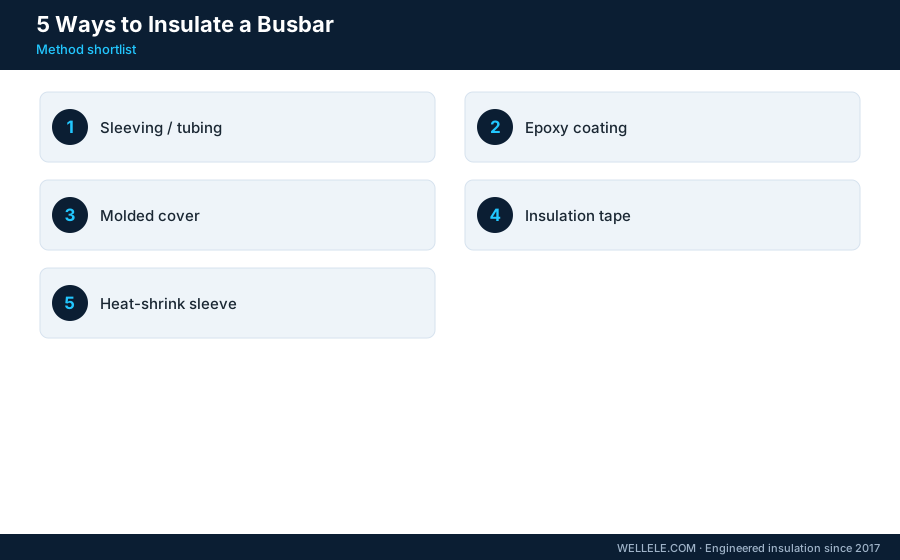
The five methods in production
| Method | Applied | Dielectric uniformity | Site modification | Typical duty |
|---|---|---|---|---|
| Heat-shrink sleeve | Field or factory | Good on straight runs, depends on installation at bends | Yes, removable | LV/MV panels, retrofits, EV/ESS |
| Epoxy powder coating | Factory only | High, pinhole-free | No | MV switchgear, prefab bus systems |
| Liquid or cast epoxy | Factory only | Highest, void-free | No | Complex geometry, partial-discharge-critical |
| Insulation tape | Field | Low, operator-dependent | Yes | Emergency repair, field patches |
| Injection-molded cover | Factory only | High | No | High-volume EV and rail parts |
Each method has a cost and a reliability profile. The mistake is picking one method for everything.
What sets the choice: voltage, geometry, environment
Three inputs settle most selections. System voltage decides whether a sleeve wall or a cured coating is even in the running; above roughly 1 kV the industry standard moves to factory-applied coatings or molded covers because dielectric performance at bends and corners has to be uniform. Geometry matters because a sleeve is a straight-run product, complex bends, lugs and bushing transitions expose installation quality. Environment decides the material grade: UV and thermal cycling outdoors, humidity in coastal sites, vibration on vehicles.
Creepage and clearance for insulated busbars
Insulation reduces but does not remove the need for spacing. For an 800 V DC pack, typical figures are 8-12 mm creepage and 5-8 mm clearance depending on pollution degree and the material's CTI (comparative tracking index). Higher system voltage, higher pollution and lower CTI all push spacing up. The insulation wall carries the dielectric load; creepage and clearance cover surface tracking, which is a different failure mode.
Standards to cite in your spec
- IEC 61439, low-voltage switchgear assemblies, temperature-rise and dielectric verification
- IEC 60684-3, heat-shrinkable sleeving, including busbar insulation
- UL 94, flame class of the insulation material (V-0 typical for this duty)
- IEEE C37.20.1 / C37.20.2, metal-enclosed switchgear bus insulation and flame testing
- ISO 6469-3 and UN R100, electric vehicle electrical safety, relevant to EV packs
- IATF 16949, automotive quality system, usually required by EV/ESS customers
Sleeve option in practice
When the duty is LV, the run is straight, or the bus system already exists and is being upgraded, a heat-shrink sleeve is usually the most practical route: it is applied with a heat gun, does not require factory curing, and can be removed when the bar is reworked. We make sleeves for this duty in standard polyolefin and in the 800V-rated grade used by EV and ESS platforms. Send us the busbar cross-section, voltage class and duty, and we will confirm the wall and ratio rather than quote a catalog number.
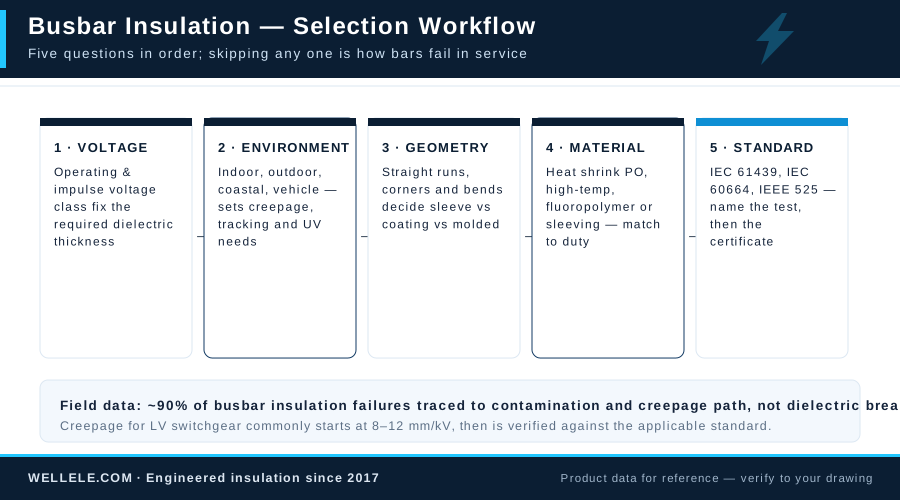
The short selection workflow
- Fix the operating voltage, continuous current and fault current
- Fix the environment: indoor, outdoor, coastal, vehicle
- Decide method: sleeve, coating, or molded, based on geometry and site access
- Specify the material grade and flame class, then the test certificate you want
The last step is the one most procurements skip. If the spec does not name the test standard, the supplier names it, and the two do not always agree.
For the head-to-head between the two most common methods, see heat-shrink sleeve vs epoxy coating.
Specifying this part?
Send the drawing for a manufacturability review.