Heat Shrink Temperature Ratings: What the Numbers on the Data Sheet Mean
Engineer's Guide · 2026-07-12
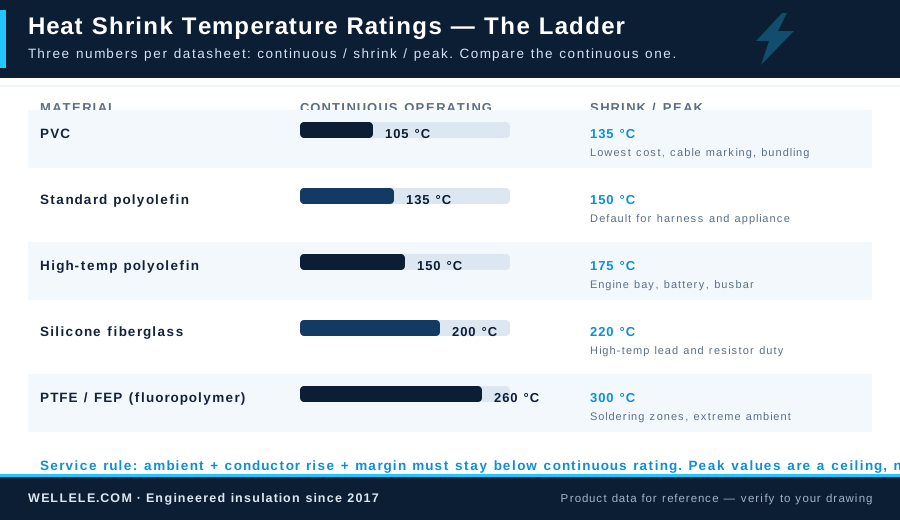
Every heat-shrink datasheet lists several temperatures, and they mean different things. Reading them as one number is how materials get specified too close to their limit, then the tubing hardens, cracks or relaxes in service, and the failure gets blamed on the product rather than the spec.
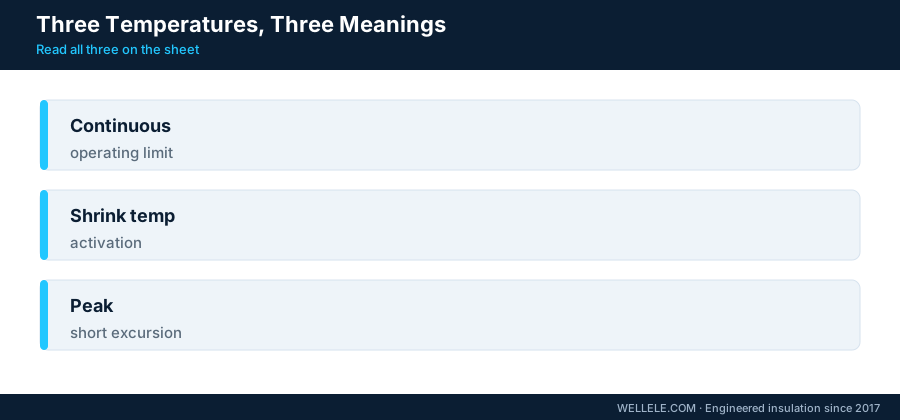
Three temperatures, three different meanings
- Continuous operating temperature, the temperature the material survives for its rated life. This is the number to compare against your worst sustained environment.
- Shrink temperature, the temperature needed to activate recovery. It is an installation parameter, not a service rating. It also tells you what tool you need: PTFE needs a professional heat gun; PVC recovers with almost any heat source.
- Peak or short-term temperature, a transient limit, usually minutes, not a working condition. Some datasheets quote it as an intermittent rating; treat it as a ceiling, not a design point.
The temperature ladder by material
| Material | Continuous | Shrink temp | Notes |
|---|---|---|---|
| PVC | -30 to +105 degC | ~100 degC | Budget indoor duty only |
| Polyolefin | -55 to +135 degC | 90-120 degC | General workhorse |
| High-temp polyolefin | up to +150 degC | 110-135 degC | Engine bay |
| PVDF | -55 to +175 degC | ~175 degC | Abrasion + chemical |
| FEP | up to +200 degC | ~190 degC | Clear, chemical-resistant |
| Silicone | -50 to +200 degC | 120-150 degC | Flex + vibration |
| PTFE | up to +260 degC | 327-340 degC | Extreme heat and chemicals |
Where ratings fail in service
- Continuous operation near the rated ceiling: the material ages fast even if it does not melt. A cable bundle in a hot enclosure derates the tubing, and nobody accounts for it.
- Thermal cycling: repeated heating and cooling relaxes radial pressure over years, and the tube loosens. Black polyolefin outdoors is the classic case.
- UV plus heat: ratings assume sheltered service. Direct sunlight adds a degradation path the temperature number does not cover.
- Wrong shrink temperature: a tube heated below its activation temperature never fully recovers and grips only where the heat happened to concentrate.
The fine print
Ratings assume an un-stressed, clean surface. A tube over a sharp edge, in contact with a solvent, or abraded by vibration will fail well below its published temperature. When in doubt, derate 15-20 percent or step up one material class.
A practical check
Add the environment temperature and the temperature rise of the conductor at full load, add a margin, and keep the sum below the continuous rating. If the total is inside the top 20 percent of the material's range, step up a class: from standard to high-temperature polyolefin, or from polyolefin to fluoropolymer. Our material range covers PVC, polyolefin, PTFE and specialty grades, so the right class is a spec question, not a sourcing problem. For the material-level tradeoffs at the top of the ladder, see PTFE vs FEP vs PEEK tubing.
Specifying this part?
Send the drawing for a manufacturability review.