Polyolefin vs PVC Heat Shrink Tubing: The Material Call Behind the Price
Material vs Material · 2026-07-30
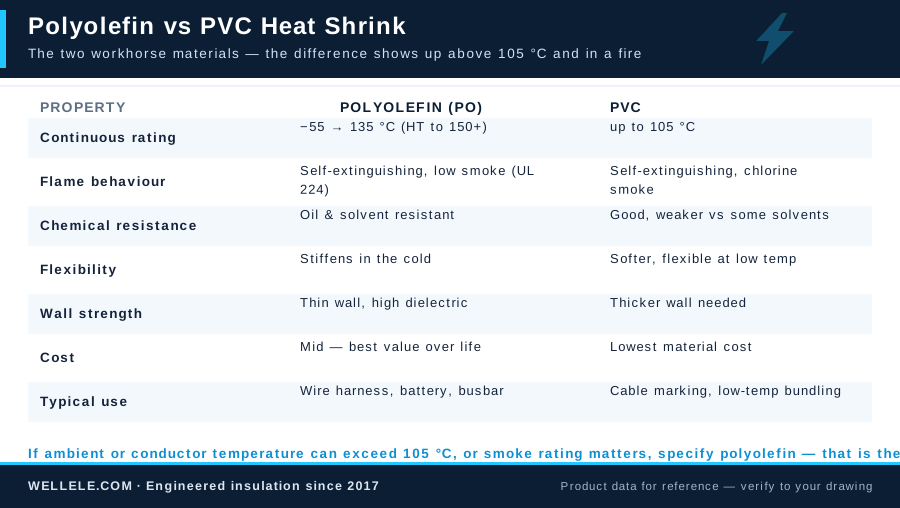
Polyolefin and PVC are the two most common heat-shrink materials, and most buyers pick by price. The specification differences are not cosmetic: they decide whether the tubing still protects the wire in the fifth year of service.
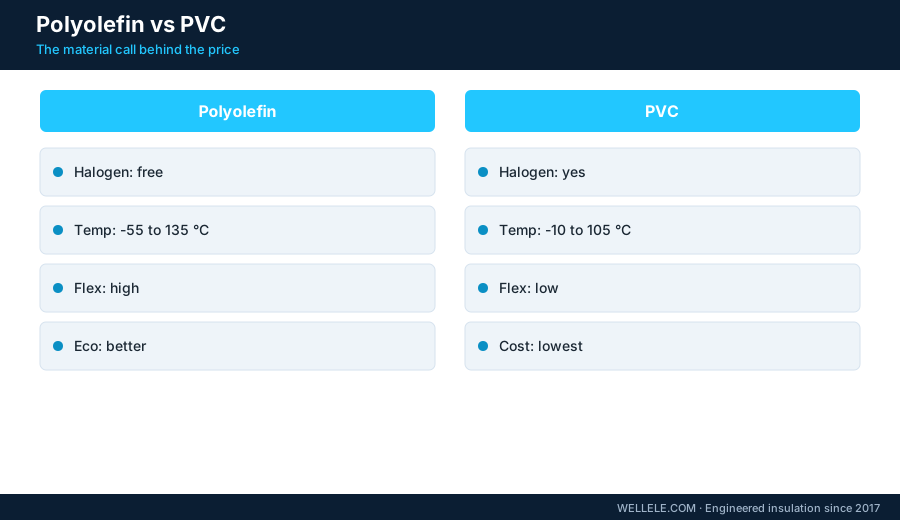
The numbers that matter
| Property | Polyolefin | PVC |
|---|---|---|
| Continuous temperature | -55 to +135 degC typical | -30 to +105 degC |
| Shrink temperature | 90-120 degC | Around 100 degC |
| Flame rating | VW-1 typical, halogen-free grades available | UL 224 flame-retardant grades, contains chlorine |
| UV resistance | Black grades good | Poor, degrades outdoors |
| Flexibility after shrink | High | Stiffens, hardens in cold |
| Relative cost | Higher | Lowest |
Polyolefin is a cross-linked material: electron-beam irradiation bonds the polymer chains, which is what gives it the wide temperature window and the elastic memory. PVC is a thermoplastic with a low heat capacity, which is why it shrinks with modest heat, even a soldering iron can recover it.
Where PVC is still specified
PVC remains a legitimate choice for indoor, low-voltage work where the environment is stable and the budget is tight: instrument panels, consumer electronics, labeling and identification. Its optical clarity is a genuine advantage when you need to read a label or inspect a wire through the sleeve. For that duty we supply PVC heat-shrink sleeving in clear and color grades.
Where PVC fails in service
- Engine compartments and any environment above roughly 105 degC continuous
- Outdoor installations: PVC degrades under UV and becomes brittle
- Cold service: PVC hardens and cracks at low temperature
- Fire: burning PVC releases chlorine gas; some industries now ban it outright
- Plasticizer migration: the tubing stiffens as additives leach over time
Every one of these failure modes has been reported to us as a field failure, not a lab scenario.
What polyolefin changes
Cross-linking gives polyolefin its shape memory and its temperature ceiling, and the formulation can be made halogen-free with a VW-1 flame rating, the combination most automotive and electrical specs now demand. Black polyolefin is the outdoor workhorse because the carbon loading provides UV stability. It is the material we default to for busbar sleeve and general harness protection.
A quick decision rule
If the wiring runs hotter than 105 degC, lives outdoors, flexes, or must meet a halogen-free requirement, specify polyolefin. If the application is indoor, low-voltage and cost-driven, PVC is defensible. When in doubt, the cost difference is small next to the cost of a harness failure, take the polyolefin.
Specifying this part?
Send the drawing for a manufacturability review.