How to Specify a Custom Fuse Tube: The Drawing Data We Actually Need
Engineer's Guide · 2026-06-20
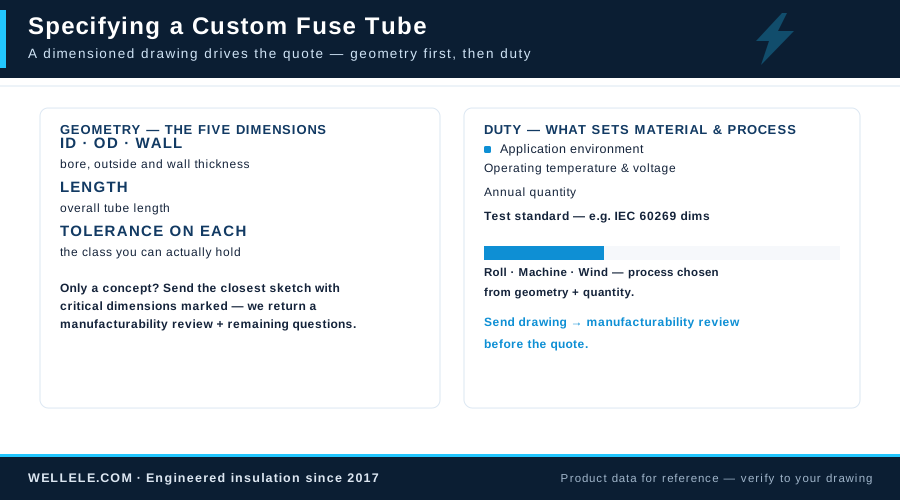
Most fuse-tube delays are not manufacturing problems. They are missing drawing data. Here is what we need to quote and make a custom tube, and what each field changes in the finished part.
Geometry first
We need inside diameter, outside diameter and length, each with its tolerance. On thin-wall or precision-bore tubes the tolerance is the part itself: a 0.05 mm bore that drifts turns into an intermittent fit problem on your line, not a cosmetic one. If the tube nests over an element or into a holder, give the mating dimension too. We would rather check the fit than guess it.
Material and grade
Name the material and grade: vulcanized fiber composite, melamine G5 or G9, a synthetic arc-quenching liner, or filament-wound glass. For melamine the NEMA grade is not optional. Composite tubes need the liner and outer wall specified, not just "fiber tube", because the bond and wall split decide burst and quench performance. If the part carries a rated fault current and a number of operations, put those numbers on the drawing. They set the wall; the catalog does not.
End form and features
Plain ends, chamfers, threaded sections, slots or pressed-in end caps all change the fixture and the inspection. A sketch of the end form saves a round of samples. If the tube is bonded to a second layer or capped, say so. That is a process step, not a finish.
Service environment
Voltage class, continuous temperature, and whether it sits indoors, outdoors, coastal or in a sealed enclosure. Outdoor and coastal duty drive moisture handling (end sealing, outer material); temperature drives the grade. A drawing that says only "insulation tube" hides the constraints that decide the material.
Quantity and cadence
Fuse-tube orders are usually small and specific: a few hundred machined pieces, not a sheet run. Tell us the lot size and whether this is a one-off or a repeating schedule. Small-batch custom is a machining-capability question, so we review the drawing for manufacturability before quoting. That way the first lot is no surprise to either side.
Where to look
Our fuse body tube and vulcanized fiber composite tube pages show the constructions we machine. Send the drawing to the quote link below for a review.
Frequently asked
What dimensions do I need on a custom fuse tube drawing?
Inside diameter, outside diameter and length, each with tolerance, plus any mating dimension if the tube nests over an element or into a holder. For thin-wall or precision-bore tubes the tolerance is the part, not a footnote.
Why must I specify a NEMA grade for a melamine tube?
G5 and G9 melamine are not interchangeable: G9 has better high-temperature and moisture behavior, G5 is the standard arc-resistant grade. A drawing that says only 'melamine' forces the supplier to guess, and guessing is how the wrong lot ships.
Do you review the drawing before quoting?
Yes. Fuse-tube orders are typically small and specific, so we check the drawing for manufacturability (geometry, grade, end form and duty) before quoting. The first lot is then no surprise to either side.
Specifying this part?
Send the drawing for a manufacturability review.