Vulcanized Fiber vs FR-4 vs GPO-3: Which Insulation Tube for Your Fuse Link
Engineer's Guide · 2026-06-20
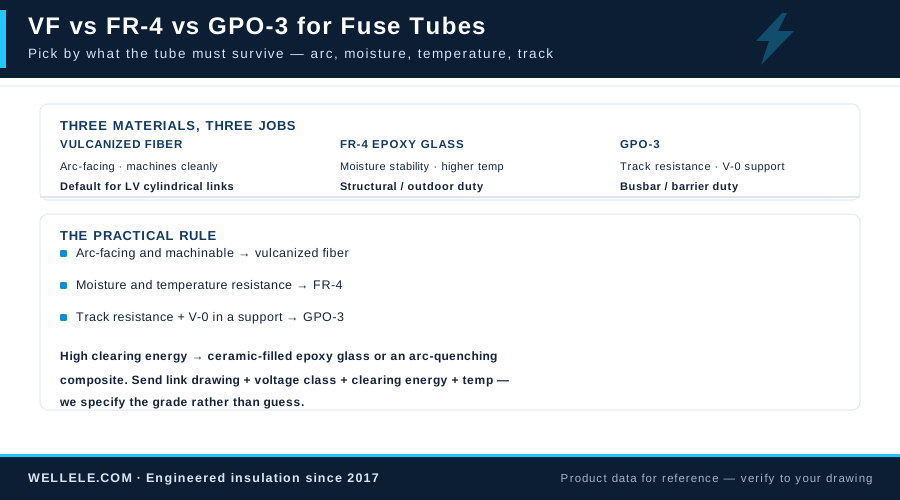
Three materials get offered for a fuse-link insulation tube: vulcanized fiber composite, FR-4 (epoxy glass), and GPO-3 (polyester glass). They are not substitutes for each other, they win on different constraints, and the constraint is usually arc duty, temperature, or whether the part is a tube or a machined shape.
The short version
| Material | Wins on | Watch out for | Typical fuse-link use |
|---|---|---|---|
| Vulcanized fiber composite | Arc quenching, machinable ID, cost | Moisture, interface bond | Cylindrical LV/MV links, combination cutout bodies |
| FR-4 / epoxy glass | Track resistance, heat, dimensional | Poor arc quench alone | Structural insulation, supports, liners in MV |
| GPO-3 (polyester glass) | Flame retardant, punchable sheet | Not a quench tube | Barriers, supports, machined insulation parts |
Arc duty decides the tube
If the tube has to survive the arc, vulcanized fiber composite is the default, it generates quench gas and machines to a precise bore. FR-4 resists tracking and heat but does not quench; it is the structural and MV-liner material, not the arc tube. GPO-3 is flame retardant and easy to punch or CNC into barriers and supports, but it is a sheet-derived part, not an arc-quenching tube.
Moisture, temperature and tracking
For damp or outdoor service, FR-4 and GPO-3 hold up better than bare fiber on moisture and tracking. The composite outer on a vulcanized fiber tube closes most of that gap. Temperature is the other divider: GPO-3 and FR-4 have defined continuous-temperature ratings; verify the grade against the enclosure temperature before specifying.
Machining and edges
GPO-3 and FR-4 machine and punch cleanly into barriers, spacers and supports, but FR-4 generates glass-fiber dust and GPO-3 can leave burrs if the tool is dull, both need deburring before they sit near a live part. Vulcanized fiber composite finishes to tube ID/OD after bonding; the consistency that matters is concentricity across the lot.
Where to look
For the composite tube itself see the vulcanized fiber fiberglass composite tube. Epoxy-glass tube stock is on the G10/G11 epoxy fiberglass tube page, and the laminated sheet category covers GPO-3, FR-4 and machined insulation parts.
Frequently asked
Which is better for a fuse link tube: vulcanized fiber or FR-4?
If the tube must quench the arc, vulcanized fiber composite is the right choice, FR-4 resists tracking and heat but does not quench. FR-4 is the structural and liner material in higher-voltage or hotter parts, not the arc tube.
Is GPO-3 used as a fuse tube?
Not as an arc-quenching tube. GPO-3 is a flame-retardant polyester-glass sheet material used for barriers, supports and machined insulation parts. It is specified alongside the fuse tube, not instead of it.
Does vulcanized fiber handle outdoor moisture?
Bare fiber soaks up moisture, which lowers surface resistivity. A composite outer tube closes most of that gap, and end sealing plus controlled storage handle the rest for damp or coastal service.
Specifying this part?
Send the drawing for a manufacturability review.