3:1 / 4:1 Dual Wall Adhesive Heat Shrink Tubing
High-ratio adhesive-lined heat shrink for irregular connectors, harness repair and waterproof sealing. One size covers a wider recovered OD range than 2:1.
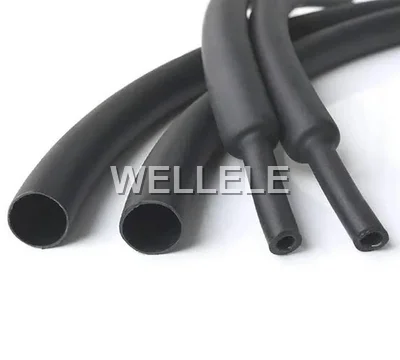
Dual wall heat shrink carries a polyolefin outer wall over an inner hot-melt adhesive layer. When heated, the outer wall recovers to roughly a quarter (4:1) or a third (3:1) of its expanded diameter while the adhesive melts, flows into gaps and sets into a flexible, water-blocking seal. The seal lives at the interface, not just on the surface, which is why it is specified for splices that sit in damp or buried environments.
The point of a 4:1 ratio is inventory, not just performance. A connector body, a bare wire and a moulded boot can differ in diameter by three or four times across one harness. With a 2:1 tube you stock several sizes to cover that spread; with a 4:1 tube a single expanded size recovers down onto the thin wire and still grips the thick connector. Field-repair kits and EV harness lines are the obvious buyers, but any build with mixed OD on one run benefits from carrying fewer SKUs.
Technical specifications
| Shrink ratio | 3:1 and 4:1 (dual wall, adhesive lined) |
| Recovered wall | Heavy-wall outer with inner adhesive flow layer |
| Operating temperature | -55 C to +125 C |
| Shrink temperature | Starts ~80 C, fully recovered ~110-130 C |
| Seal rating | IP68 when correctly recovered (adhesive interfaces) |
| Standards | RoHS; UL 224 style; SAE AMS-DTL-23053/4 class 3 |
| Flammability | VW-1 available |
Applications by industry
- EV and hybrid powertrain harness splices
- Automotive and commercial-vehicle wiring repair
- Marine and rail harness waterproofing
- Field-repair kits for trucks, buses and off-road equipment
- Irregular connector backshells and breakouts
- Connector OEM sealing of mixed-diameter joins
Why a 4:1 ratio instead of 2:1
A 4:1 tube recovers to one quarter of its supplied diameter. A 12 mm expanded tube seats on a 3 mm wire yet still closes over a 10 mm connector, so one part covers an OD range that would need two or three 2:1 sizes. That cuts the number of items a harness line or service kit has to hold, and it removes the on-site error of grabbing the wrong tube for an odd connector. The cost per metre is higher; the saving is in stock and in fewer mis-applied joints.
Adhesive flow and the shrink window
The adhesive has to flow before the outer wall fully shrinks, so heat has to be applied evenly and long enough for the liner to wet the substrate -- not just until the tube looks tight. A cold spot leaves a dry seal that leaks later. Overheating chars the polyolefin without improving the bond. On a harness with nearby heat-sensitive parts, a controlled hot-air tool with a reflector beats a broad torch.
Inspection and traceability
We hold dimensional and seal checks per your drawing. Adhesive-bond and immersion tests are run on request for automotive and marine qualification.
- Expanded and recovered ID check against specification
- Wall-thickness measurement at multiple points
- Adhesive bond and immersion (IP68) test on request
- Salt-spray and fluid-resistance test on request
- Lot traceability to raw tubing batch
Related components
Fluoropolymer Heat Shrink Tubing
For chemical and higher-temperature duty the polyolefin cannot take.
2:1 PFA Heat Shrink Tubing
Fluoropolymer alternative where chemical resistance beats ratio.
Polyimide Tubing
When continuous temperature exceeds 200 C.
Common questions
When should I use 4:1 instead of 2:1?
When one joint spans a large OD range -- a thick connector on a thin wire, or a moulded boot meeting bare cable. The 4:1 recovers down far enough to grip both with a single size.
Does the adhesive actually seal against water?
Yes, if recovered correctly. The inner layer flows into gaps and sets; immersed and salt-spray checks are available, but the surface must be clean and dry first.
Can it cover an irregular connector shape?
That is the main reason to use it. The high ratio plus flowing adhesive follows steps and corners that a thin-wall 2:1 tube would bridge without contact.
What temperature can it handle?
Typical continuous service is -55 C to +125 C. Above that, move to fluoropolymer or polyimide.
Is it suitable for marine use?
Yes, the adhesive seal is the reason marine and rail harnesses specify dual wall. Confirm the fluid-resistance grade for the specific environment.
Engineering Guides & Selection Notes
Engineering notes covering the sizing and specification questions around 3.
Get pricing for 3:1 / 4:1 Dual Wall Adhesive Heat Shrink Tubing
Give the expanded and recovered OD range, length per piece, environment (automotive / marine / buried) and annual volume. We suggest the lowest ratio that still covers your spread.