Filament Wound Epoxy Fiberglass Tube
Thin-wall, close-tolerance filament-wound epoxy glass tube for switchgear, breaker, medical, aerospace and cryogenic insulation.
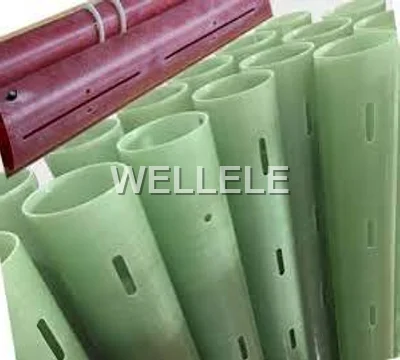
Filament winding lays continuous glass rovings in epoxy resin around a mandrel, so the fibers run the full length of the tube with no joins. That gives the highest hoop strength for a given wall and the best concentricity of any round tube process, which is why it is the choice when the wall is thin, the tolerance is tight and the part has to be both strong and insulating. The trade is cost and lead time versus a rolled or pultruded tube.
The buyers are the ones who cannot accept a seam or a wall variation: breaker and interrupter makers, medical-equipment OEMs, aerospace and cryogenic suppliers, and fuse OEMs where the tube is a structural insulator, not a cover. They send a drawing with a thin wall and a close ID/OD, and we wind to it and machine the ends without cracking the laminate.
Technical specifications
| Process | Continuous filament winding, epoxy + E-glass |
| Wall | Thin-wall capability (from ~0.5 mm) |
| Tolerance | Close ID / OD and concentricity |
| Strength | High hoop strength, good strength-to-weight |
| Dielectric | Strong electrical insulation |
| Temperature | Epoxy service, typically -50 C to +130 C (grade dependent) |
| Supply | Custom ID/OD/wall and machined ends |
Applications by industry
- Switchgear and breaker OEM insulation
- Interrupter and fuse structural tubes
- Medical equipment insulation components
- Aerospace and precision tubing
- Cryogenic and low-temperature equipment
- Industrial machinery insulating sleeves
Filament winding vs rolled or pultruded tube
A rolled tube is built from sheet wound on a bias and has a seam; a pultruded tube pulls profile through a die and is cheaper but lower in hoop performance. Filament winding has neither seam nor compromise on hoop strength because the fibers are continuous and oriented for the load. For a thin wall that must stay round and insulated under pressure, that is the process that holds the tolerance. The cost is higher and the run longer, which is why it is specified where performance, not price, leads.
Machining thin walls without delamination
Thin-wall composites delaminate if the tool rubs instead of cutting, so we machine with sharp tooling, proper support and controlled feed, and we deburr the edges so no lifted glass starts a track. The inspection point is the bore and the end-squareness: a skewed or burred end seats badly in a breaker or interrupter and concentrates stress. Small, odd-shaped cross-sections are normal, not a problem.
Inspection and traceability
We check ID/OD/wall and concentricity, verify end-squareness and edge quality, and run burst and dielectric checks on request with lot traceability.
- ID / OD / wall and concentricity measurement
- End-squareness and edge-quality check
- Burst-strength check on request
- Dielectric test on request
- Lot traceability for qualified programs
Related components
G5 / G9 Melamine Tubes
Arc-resistant machined laminate.
Vulcanized Fiber Composite Tube
Composite for arc-chamber duty.
Polyimide Tubing
Higher-temperature thin-wall option.
Common questions
When should I specify filament winding over a rolled tube?
When the wall is thin, the tolerance is tight and the tube is structural -- breaker, interrupter, aerospace, cryogenic. Rolled tubes are fine for non-critical covers.
How thin can the wall go?
Thin-wall capability starts around 0.5 mm depending on diameter and strength need; send the drawing and we confirm.
What tolerance can you hold?
Close ID/OD and concentricity are the point of the process; the exact number follows the diameter and wall on your drawing.
Can you machine the ends without cracking?
Yes, with sharp tooling, support and controlled feed; edges are deburred and checked so no fiber lifts to start a track.
What environments suit it?
Epoxy grades cover typical -50 C to +130 C; for cryogenic or medical duty state it so we select the right resin system.
Engineering Guides & Selection Notes
Engineering notes covering the sizing and specification questions around Filament Wound Epoxy Fiberglass Tube.
Get pricing for Filament Wound Epoxy Fiberglass Tube
Send ID, OD, wall, tolerance, environment and quantity. We confirm the epoxy grade and the machinable thin-wall option.