Engineered Filament-Wound Epoxy Glass Tubing
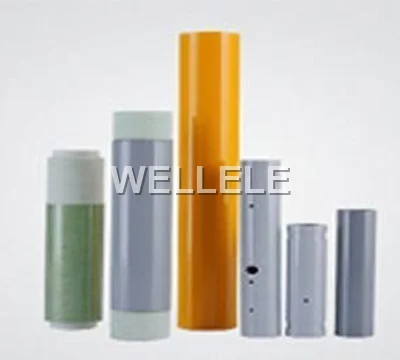
Wound to a fiber angle set by your load path, then machined to shape. Filament winding lets us place glass where the load is. We set the wind angle from your pressure or column load, then machine the tube to casing, bushing or structural shape. Send the load case, ID/OD, length, temperature and any flame class. We return the winding schedule and a manufacturability review before quotation.
Technical specifications
| Material | Epoxy-impregnated E-glass / ECR |
| Temp class | F/H, up to ~155-180 degC |
| Dielectric | >14 kV/mm through thickness |
| Wind angle | Set from load path |
| Flame | UL 94 V-0 on FR-4 grade |
💾 Datasheets & Test Reports
Download the technical data sheet for this product (PDF).
Applications by industry
- MV/HV bushing core and insulating bodies
- Transformer lead-out tubes with mechanical load
- Insulator structures where glass strength is required
- Air-core reactor and coil insulating tubes
- Switchgear interphase and barrier tubes
- Engineered tube stock with tuned winding angle
Why filament-wound epoxy glass for this application
Epoxy resin over oriented glass gives the highest strength-to-weight dielectric tube for bodies that must hold conductors or bushings under mechanical and temperature load together.
Confirm resin cure, temperature class and CTI; wound angle and void control decide both the kV withstand and the mechanical rating.
Standards: ASTM D709, IEC 60672, IEC 60137 (bushing core).
Feature and remaining-wall review
Machining Filament-Wound Epoxy Glass Tubing uses diamond-coated tools so the edges stay clean, with CNC turning, grinding and drilling to your drawing. Dimensional stability is good when moisture content is controlled. Feature depth, edge distance and remaining wall are reviewed before quotation, and capability follows your drawing rather than a general tolerance.
Inspection and traceability
We state the control plan with you. Batch traceability links raw material lot to finished part.
- First-article inspection (FAI) per your plan
- In-process dimensional checks at every station
- Batch certificate of conformance (COA) supplied on request
- Lot traceability to incoming material certificate
- Dielectric strength and insulation resistance testing available on request
Related components
Filament Fiberglass Wound Tubing
Related insulation component from the WELLELE catalog.
Shaped HV Casing Parts (FR-4/G10)
Related insulation component from the WELLELE catalog.
PV Insert Epoxy Fiberglass Tubes
Related insulation component from the WELLELE catalog.
Common questions
Which grade of Engineered Filament-Wound Epoxy Glass Tubing do I need?
Send the service conditions for Filament-Wound Epoxy Glass Tubing, meaning voltage, temperature and the loads it has to carry, and we will point at the grade in the table above. If the duty is unusual we will tell you instead of guessing.
Which material is Engineered Filament-Wound Epoxy Glass Tubing manufactured from?
The material is Epoxy-impregnated E-glass / ECR. Alternate grades can be quoted against your drawing.
Is a material certificate of analysis provided for Engineered Filament-Wound Epoxy Glass Tubing?
Yes. A material certificate of analysis accompanies every batch of Filament-Wound Epoxy Glass Tubing, and first-article inspection or additional electrical testing can be added to your specification.
Can Engineered Filament-Wound Epoxy Glass Tubing be produced to a customer drawing?
For Filament-Wound Epoxy Glass Tubing, bore, wall and cut length follow your drawing. Give us the drawing and the target quantity, and feasibility and price come back together.
Engineering Guides & Selection Notes
Technical articles that go deeper on selecting and specifying Filament-Wound Epoxy Glass Tubing.
Get pricing for Engineered Filament-Wound Epoxy Glass Tubing
For Filament-Wound Epoxy Glass Tubing, attach the drawing plus the annual volume. Material, tolerance, ID, OD, wall and features all get checked against it before we quote, and the manufacturability notes for Filament-Wound Epoxy Glass Tubing come with the price.