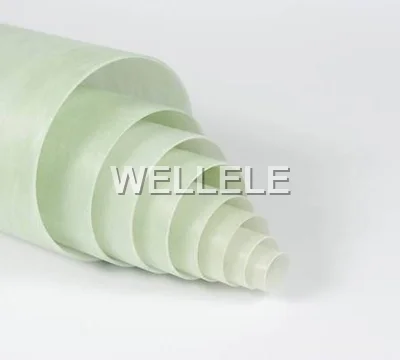
Filament-Wound Fiber Glass Rocket and Motor Tubes
Composite motor-case tubing wound to pressure and thrust load. Rocket and motor tubes are pressure vessels. We wind them to the case pressure and thrust load with a fiber angle that carries both hoop and axial stress. We work from the motor drawing and qualification plan, and we document winding, cure and inspection per aerospace or commercial requirement.
Technical specifications
| Material | Epoxy E-glass / ECR filament wound |
| Load | Hoop + axial from thrust |
| Docs | Winding, cure, inspection records |
| Standard | ASTM D2583 (G10), IPC-4101 (FR-4), IEC 60672 (thermal). |
| Operating temperature | -40 °C to +130 °C |
| Dielectric strength | ≥ 20 kV/mm (per ASTM test method) |
💾 Datasheets & Test Reports
Download the technical data sheet for this product (PDF).
Applications by industry
- Model rocket motor and body tube stock
- High-pressure composite pressure-vessel liners
- Sport rocket casing and airframe structural tubing
- Composite drive shaft and tube stock for prototype builds
- Lightweight high-strength tube for aerospace test articles
- Custom ID/OD composite tubing for high-strain applications
Why filament-wound fiberglass for this application
Bidirectional glass winding delivers the hoop strength a motor case or rocket airframe needs at low weight, which is exactly why this composite tube is chosen over metal for impact and weight-critical builds.
p>This is a structural product, not an insulator request. Confirm winding angle, burst/testing requirement and resin cure before build. Do not use as electrical tube unless specced. confirm winding angle, burst/testing requirement and resin cure before build. Do not use as electrical tube unless specced.Standards: ASTM D2584 / D3039 (composite testing), NAR/TRA motor casing standards where applicable.
Feature and remaining-wall review
For Filament-Wound Fiber Glass Rocket and Motor Tubes we use diamond-coated tooling for clean edges and CNC turning, grinding and drilling to drawing. Controlled moisture content keeps dimensional stability where it should be. Feature depth, edge distance and remaining wall are reviewed against critical geometries, and capability is confirmed on your print, not from a blanket tolerance.
Inspection and traceability
We state the control plan with you. Batch traceability links raw material lot to finished part.
- First-article inspection (FAI) per your plan
- In-process dimensional checks at every station
- Batch certificate of conformance (COA) supplied on request
- Lot traceability to incoming material certificate
- Dielectric strength and insulation resistance testing available on request
Related components
Filament-Wound Epoxy Tubing
Related insulation component from the WELLELE catalog.
Filament Fiberglass Wound Tubing
Related insulation component from the WELLELE catalog.
Shaped HV Casing Parts (FR-4/G10)
Related insulation component from the WELLELE catalog.
Common questions
How is Filament-Wound Fiber Glass Rocket and Motor Tubes specified?
We specify Filament-Wound Fiber Glass Rocket and Motor Tubes from the assembly duty rather than a datasheet number. Send the voltage, the working temperature and the mechanical load, and we confirm the grade.
What material is used for Filament-Wound Fiber Glass Rocket and Motor Tubes?
The material is Epoxy E-glass / ECR filament wound. Alternate grades can be quoted against your drawing.
Is material certification supplied with Filament-Wound Fiber Glass Rocket and Motor Tubes?
Traceability for Filament-Wound Fiber Glass Rocket and Motor Tubes comes with each batch as a material certificate of analysis. First-article reports and dielectric testing run to the method you name.
Can Filament-Wound Fiber Glass Rocket and Motor Tubes be made to our drawing?
We supply bore, wall and cut length on Filament-Wound Fiber Glass Rocket and Motor Tubes to your drawing. Both the drawing and the planned run quantity go into the quotation.
Engineering Guides & Selection Notes
Related reading on the selection and specification decisions behind Filament-Wound Fiber Glass Rocket and Motor Tubes.
Get pricing for Filament-Wound Fiber Glass Rocket and Motor Tubes
The quote for Filament-Wound Fiber Glass Rocket and Motor Tubes starts from your drawing and the annual volume. We verify the material against the duty and tolerance, confirm ID, OD, wall and every feature of Filament-Wound Fiber Glass Rocket and Motor Tubes, and reply with manufacturing notes and pricing.