Fuse Body Tube for Power Protection
Arc-quenching fuse tubes and barrels for expulsion, current-limiting and distribution fuse links, built to the fuse type and the fault duty.
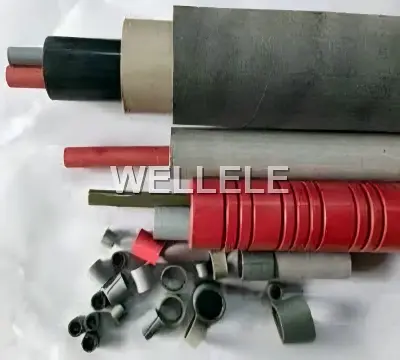
A fuse body tube is not a passive housing -- during a fault it is the arc-quenching element. In an expulsion fuse the tube wall decomposes and vents gas to drive the arc out; in a current-limiting fuse it contains and cools the arc long enough to clear the circuit. The material, wall and concentricity therefore have to be matched to the fuse type, the voltage and the fault current, not picked from a catalogue.
We work from the fuse design rather than a stock list. Dropout and cutout OEMs, current-limiting fuse makers and switchgear component suppliers send the fuse type and the duty, and we set the material route, then hold the dimensions, the drilled or threaded ends and the batch consistency that a type-test package demands. A tube that is a few thousandths off on ID, or soft on burst strength, fails in the lab and wastes a qualification cycle.
Technical specifications
| Material routes | Vulcanized fiber; phenolic; vulcanized-fiber/fiberglass composite |
| Matched to | Expulsion, current-limiting and distribution fuse types |
| Dimensions | ID / OD / length to fuse drawing; concentricity controlled |
| End features | Drilled, threaded or machined ends per design |
| Performance | Arc-quenching and burst-strength per fault duty |
| Consistency | Lot-to-lot material and dimensional control |
| Evidence | Type-test samples and batch CoA on request |
Applications by industry
- Fuse manufacturers and fuse-link OEMs
- Dropout and cutout fuse OEMs
- Current-limiting fuse manufacturers
- Switchgear and utility component suppliers
- Insulator and HV component makers
- Distribution fuse body and barrel supply
What the tube actually does during a fault
In an expulsion fuse the wall generates quenching gas when the arc heats it; that gas pressure drives the arc to stretch and extinguish at a current zero. In a current-limiting type the wall has to contain and cool the arc within a tight envelope. Either way the tube is a working component: its burst strength, wall uniformity and material stability under arc heat decide whether the fuse clears or fails mechanically. That is why the material is chosen per fuse type, not per price.
Machining, threads and fit
The tube has to meet the contacts and the end fittings without a gap that lets the arc bypass the quenching path. Drilled and threaded ends must hold position and not crack the wall; concentricity keeps the arc centered so the wall erodes evenly instead of blowing out one side. We hold these on the drawing and report them per lot so your assembly stays within the qualified envelope.
Inspection and traceability
We control material incoming certificate, dimensional and concentricity checks, and burst/arc verification on request, with lot traceability for type-tested programs.
- Incoming material certificate per lot
- ID / OD / length and concentricity checks
- End machining and thread verification
- Burst-strength and arc test on request
- Batch certificate of conformance for qualification
Related components
G5 / G9 Melamine Tubes
Arc-resistant laminate alternative for fuse bodies.
Vulcanized Fiber Composite Fiberglass Tube
Composite body with higher burst strength.
Composite Sleeve for Dropout Fuse
Arc-quenching tube for cutout duty.
Common questions
Which material do you use for a fuse tube?
It follows the fuse type and fault duty -- vulcanized fiber for expulsion, phenolic or composite for current-limiting, melamine laminate where arc resistance and machining matter. Send the fuse type first.
What does the tube do during a fault?
It quenches or contains the arc. In expulsion types it vents gas; in current-limiting types it contains and cools the arc. The wall is a working component, not a housing.
Can you machine the ends and threads?
Yes -- drilled, threaded and turned ends are held to the fuse drawing, with concentricity controlled so the arc stays centered.
Do you support type testing?
We supply lot-controlled samples and batch certificates, and run burst/arc verification on request.
Why not just use the cheapest tube?
The body is part of the qualified arc system. A grade change can void the type test even with identical dimensions.
Engineering Guides & Selection Notes
Technical articles that go deeper on selecting and specifying Fuse Body Tube.
Get pricing for Fuse Body Tube for Power Protection
Send the fuse type, voltage and fault current, plus the tube drawing (ID/OD/length/ends). We set the material route and confirm lot-controlled supply.