G5 / G9 Melamine Tubes for Arc-Resistant Fuse Bodies
Glass-melamine laminate tubes (NEMA G5 / G9) for fuse bodies and HV components where arc resistance and machined precision matter.
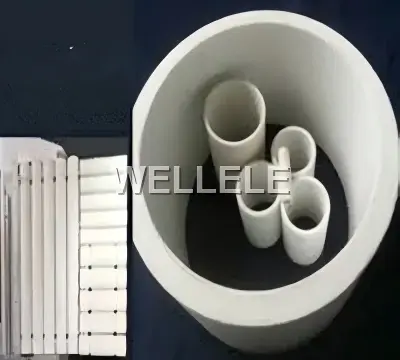
Melamine glass laminate is the material you reach for when a fuse body has to resist an arc without carving a conducting path into its surface, and still be machined to a precise shape. NEMA G5 and G9 are the two grades in play: both use glass cloth with a melamine resin, and G9 carries the higher arc- and heat-resistance rating. They hold dimension under heat better than many phenolics and do not carbonize into a conductive track the way untreated organics do.
The buying constraint is usually grade recognition and small-batch machining. Fuse OEMs and insulation machining houses specify G5 or G9 by the standard, then ask for turned, drilled or slotted tubes in quantities that do not suit a high-volume moulding line. We treat these as machined laminate parts: correct grade, correct grain direction, clean edges, and a dimensional report that matches the drawing.
Technical specifications
| Grade | NEMA G5 and G9 glass-melamine laminate |
| Arc resistance | High (ASTM D495); G9 rated above G5 |
| Machining | CNC turned, drilled, slotted tubes |
| Dimensional | Tight ID/OD and length per drawing |
| Thermal | Better dimensional stability than phenolic under arc heat |
| Dielectric | High insulation strength for HV components |
| Supply | Small-batch custom machining supported |
Applications by industry
- Fuse OEM fuse-body tubes
- Switchgear and HV component insulation
- Arc-resistant fuse and interrupter parts
- Electrical insulation fabricators
- Specialty laminate distributors
- Machined insulating sleeves and spacers
G5 vs G9 and when the grade matters
Both are glass-melamine, but G9 is the higher-performance grade: better arc resistance and better retention of properties under heat. If the fuse body sees repeated or high-energy arcing, or the part sits in a hotter zone, G9 earns the premium. G5 is the general-duty choice where the arc load is lower and cost is the deciding factor. Specifying the wrong grade is the common mistake -- buyers quote "melamine tube" without stating G5 or G9, and the received part may not match the qualified design.
Machining without cracking the laminate
Melamine laminate machines cleanly but punishes dull tooling and wrong feed with edge delamination. We machine with sharp carbide, control heat at the cut, and deburr the edges so there is no lifted glass fibre to start a track. For tubes that meet a contact or end fitting, ID and end-squareness are held to the drawing because a skewed tube seats badly and concentrates the arc.
Inspection and traceability
We verify grade against incoming certificate, check dimensions and edge quality, and provide a report per lot for qualified fuse and HV programs.
- Grade verification against material certificate
- ID / OD / length and end-squareness checks
- Edge-quality check for delamination
- Arc-resistance grade confirmed (G5 vs G9)
- Dimensional report per lot
Related components
Fuse Body Tube
Broader fuse-tube family by fuse type.
Vulcanized Fiber Composite Tube
Composite alternative with higher burst strength.
Filament Wound Epoxy Fiberglass Tube
High-strength thin-wall insulation.
Common questions
What is the difference between G5 and G9 melamine?
Both are glass-melamine laminate; G9 has higher arc resistance and better heat stability. Use G9 where arcing energy or temperature is higher, G5 for general duty.
Why does melamine resist arcing better than phenolic?
The melamine resin does not carbonize into a conductive track as readily, and it holds dimension under arc heat better than many phenolics.
Can you machine small batches?
Yes -- turned, drilled and slotted tubes in small lots are the normal supply model, with a dimensional report per lot.
How do I avoid the wrong grade shipping?
State NEMA G5 or G9 on the drawing. Quoting only "melamine tube" leaves the grade open and risks a mismatch with your qualified design.
Does it need special edge finishing?
Yes -- deburring matters. Lifted glass at an edge is a starting point for tracking, so edges are checked as part of inspection.
Engineering Guides & Selection Notes
Technical articles that go deeper on selecting and specifying G5 / G9 Melamine Tubes.
Get pricing for G5 / G9 Melamine Tubes for Arc-Resistant Fuse Bodies
Send the drawing with NEMA grade (G5 or G9), dimensions, tolerances and any machined features, plus quantity. We confirm machinability and lot reporting.