Polyimide (Kapton) Capillary Tubes for Temperature Sensors
Thin-wall polyimide capillary for thermocouple and RTD protection. Polyimide capillary protects sensor elements while staying thin and flexible across a wide temperature span. We draw it to the sensor OD with tight wall. Used as a sheath or liner for thermocouples and RTDs where space and response time matter.
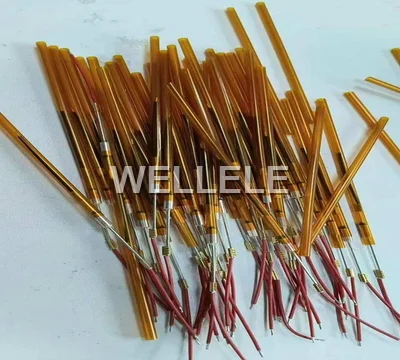
Technical specifications
| Material | Polyimide (Kapton) |
| Temperature | -269 to +400 degC |
| Wall | Thin, tight tolerance |
| Use | Thermocouple / RTD sheath |
Applications by industry
- RTD and thermocouple sensor capillary sleeving
- High-temperature probe wire insulation
- Aerospace and lab instrument sensor leads
- Thin-wall insulating tubing over fine sensor wires
- Heat-shrinkless precision slewing for signal pairs
- Sensor fatigue and moisture barrier sleeving
Why polyimide (Kapton) for this application
Polyimide handles wide temperature swings with a thin wall and low creep, keeping small sensor-millivolt signals cleanly isolated even near hot probes.
p>Hygroscopic unless conditioned/coated; confirm moisture and dielectric vs service. Thin wall + heat can still degrade, derate for continuous high temp.Standards: IEC 60672, ASTM D5487, IPC (film basis).
Feature and remaining-wall review
Polyimide (Kapton) Capillary Tubes is sintered to size on ID and OD, then CNC turned for ends, slots and holes. PTFE needs sharp tooling to stop chatter. Feature depth, edge distance and remaining wall go through review on Polyimide (Kapton) Capillary Tubes against the critical geometries, with capability confirmed on your print rather than a general tolerance.
Inspection and traceability
We state the control plan with you. Batch traceability links raw material lot to finished part.
- First-article inspection (FAI) per your plan
- In-process dimensional checks at every station
- Batch certificate of conformance (COA) supplied on request
- Lot traceability to incoming material certificate
- Dielectric strength and insulation resistance testing available on request
Related components
PTFE Tubing for Medical Devices
Related insulation component from the WELLELE catalog.
Mylar Shrink Tubing
Related insulation component from the WELLELE catalog.
Silicone-Coated Fiberglass Sleeving
Related insulation component from the WELLELE catalog.
Common questions
Where would you specify Polyimide (Kapton) Capillary Tubes for Temperature Sensors?
Typical applications are Thermocouple / RTD sheath. Give us the duty plus the environment, and we will either confirm this grade for Polyimide (Kapton) Capillary Tubes or point you at the one that fits.
Which material is Polyimide (Kapton) Capillary Tubes for Temperature Sensors manufactured from?
The material is Polyimide (Kapton). Alternate grades can be quoted against your drawing.
Is a material certificate of analysis provided for Polyimide (Kapton) Capillary Tubes for Temperature Sensors?
A material certificate of analysis goes out with each batch of Polyimide (Kapton) Capillary Tubes. Add first-article inspection or dielectric strength testing if your quality plan requires the report.
Can Polyimide (Kapton) Capillary Tubes for Temperature Sensors be produced to a customer drawing?
We hold bore, wall and cut length on Polyimide (Kapton) Capillary Tubes to your drawing. Give us the print and the quantity you need and the quotation is built on it.
Engineering Guides & Selection Notes
Engineering notes covering the sizing and specification questions around Polyimide (Kapton) Capillary Tubes.
Get pricing for Polyimide (Kapton) Capillary Tubes for Temperature Sensors
The quote for Polyimide (Kapton) Capillary Tubes starts from your drawing and the annual volume. We verify the material against the duty and tolerance, confirm ID, OD, wall and every feature of Polyimide (Kapton) Capillary Tubes, and reply with manufacturing notes and pricing.