Polyimide Tubing (PI / Kapton Tubing)
Precision thin-wall polyimide tubing for semiconductor probe cards, test sockets and motor insulation. Tight ID/OD, clean cut, high temperature.
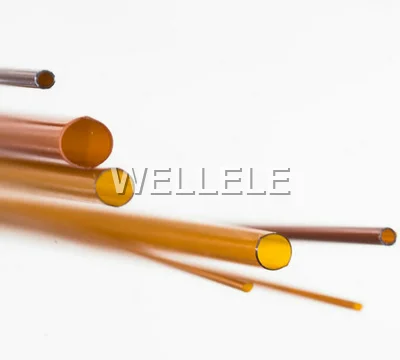
Polyimide tubing is the precision end of the polymer-tube range: extremely thin walls, very tight ID/OD control, high temperature capability and excellent dielectric strength. The dominant use is semiconductor test -- probe cards, test sockets and spring-probe assemblies -- where a few tenths of a millimetre of concentric, burr-free tube decides whether a contact seats cleanly and repeatedly.
This is the highest-score line in the plan because advanced packaging keeps pushing probe-test density, and buyers -- probe-card OEMs, test-socket makers, spring-probe and ATE suppliers -- qualify on micro-dimensions and batch consistency, not price. We lead with a micro-capability table and samples, and treat it as a country-pool-first motion into the semiconductor test supply chain rather than a material listing.
Technical specifications
| Material | Polyimide (PI), Kapton-class |
| Wall thickness | Ultra-thin wall, micro sizes available |
| ID / OD | Tight tolerance, high concentricity |
| Continuous temperature | Up to ~260 C (PI grade dependent) |
| Dielectric strength | High, suitable for precision insulation |
| Finish | Clean cut, low particulate, low burr |
| Form | Extruded or wound, by specification |
Applications by industry
- Semiconductor probe-card tubing and guides
- Test-socket and spring-probe insulation
- ATE and precision sensor tubing
- Motor and coil winding insulation
- High-temperature wire and component sleeving
- Micro-fluid and analytical instrument tubing
Why polyimide for precision test tubing
For probe-card and test-socket work the tube has to be thin, dimensionally exact and thermally stable, and it has to survive repeated insertion without shedding. Polyimide holds wall and OD tighter than most films, stays stable at temperature, and gives a clean, low-burr cut. Against PTFE it is stiffer and easier to hold a tolerance on; against Nomex or PET it survives higher temperature and holds thinner walls.
Tolerance and concentricity review
Micro tubing lives or dies on concentricity and cut quality. We hold ID/OD to a stated tolerance, control concentricity so the wall is even around the bore, and clean-cut to avoid burrs that would foul a probe. Specify the bore and wall you actually need, not a catalogue size, and we will confirm capability.
Inspection and traceability
We set the control plan for Polyimide Tubing (PI / Kapton Tubing) together with you. Each batch traces from the resin lot through to the finished tube and the inspection record.
- ID / OD checked to stated micro-tolerance
- Concentricity controlled on every lot
- Clean-cut, low-burr finish for probe use
- Lot traceability to incoming material certificate
- Dimensional report and sample lot on request
Related components
PTFE / FEP / PFA Heat Shrink
Where low-friction release is needed.
2:1 PFA Heat Shrink Tubing
High-purity fluoropolymer sleeving.
PTFE Tubing for Medical Devices
Biocompatible non-shrink PTFE.
Common questions
Polyimide vs PTFE tubing -- which to choose?
Polyimide for thin-wall precision and high temperature with tight ID/OD; PTFE where low friction and chemical release matter more than dimensional rigidity.
What tolerance can you hold on thin-wall PI tube?
Tight ID/OD with controlled concentricity; state the bore, wall and tolerance and we confirm capability against a drawing.
Is it suitable for probe-card use?
Yes. Probe-card and test-socket tubing is a primary application; clean-cut, burr-free finish is standard for that use.
Extruded or wound polyimide tube?
Both are possible; extruded gives tighter, more consistent thin walls for micro sizes. We advise by application.
What temperature can polyimide tubing take?
Around 260 C depending on grade; confirm the continuous duty before qualification.
Engineering Guides & Selection Notes
Technical articles that go deeper on selecting and specifying Polyimide Tubing (PI / Kapton Tubing).
Get pricing for Polyimide Tubing
Send the bore, wall, tolerance, concentricity requirement and annual volume. We confirm micro-capability and sample lead time.