Vulcanized Fiber Composite Fiberglass Tube
Composite tube pairing vulcanized fiber (arc-quenching) with glass fiber (burst strength) for fuse and interrupter arc chambers.
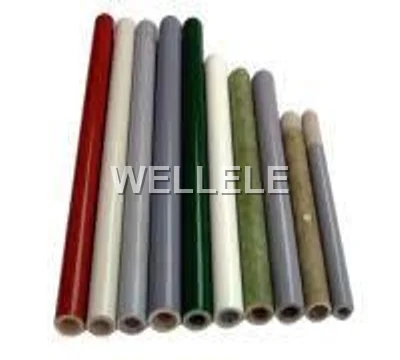
A vulcanized-fiber / fiberglass composite tube is an engineering answer to a single-material limit. Vulcanized fiber quenches an arc by generating gas, but on its own it softens with moisture and has modest burst strength. Wrapping or lining it with glass fiber adds hoop strength and dimensional stability. The composite is tuned so the fuse or interrupter gets both the quenching and the mechanical containment it needs from one tube.
This is a material-route decision, not a catalogue pick. Fuse, cutout and interrupter makers come with a duty -- voltage, fault current, number of operations -- and we set the fiber content, the resin and the interface so the tube survives the arc and the pressure without splitting. The interface between the two materials is where these tubes live or die, so bonding and moisture control are the first things we qualify.
Technical specifications
| Structure | Vulcanized fiber with glass-fiber reinforcement |
| Properties | Arc quenching + improved burst strength |
| Moisture | Controlled absorption versus plain vulcanized fiber |
| Dimensions | ID / OD / length to drawing; tight tolerance |
| Arc duty | Matched to fuse / interrupter fault level |
| Machining | Turned, drilled, slotted ends per design |
| Supply | Lot-controlled with material certificate |
Applications by industry
- Fuse OEM arc-chamber tubes
- Cutout and dropout fuse OEMs
- Breaker and interrupter manufacturers
- Electrical insulation converters
- Utility component manufacturers
- Composite fuse-tube replacement programs
Why a composite beats a single material
Vulcanized fiber alone is a good arc-quencher but it drinks water and its burst strength is limited; glass fiber alone is strong but does not quench. Put them together and you get a tube that vents and contains at the same time. For an interrupter that opens repeatedly, or a cutout in a humid climate, that combination is the difference between a tube that clears and a tube that bursts. The design work is in the ratio and the bond, not in picking one material.
Interface, moisture and machining
We control the bond so the layers move together under pressure, and we manage moisture uptake so the tube does not swell or lose strength in storage and service. Machining follows the fuse or interrupter drawing -- turned ends, drilled ports, slots -- with the same concentricity and edge care as the single-material tubes, because an out-of-square end still concentrates the arc.
Inspection and traceability
We verify incoming material certificates, check the bond and dimensions, and run burst and arc verification on request with lot traceability.
- Incoming material certificate per layer
- Bond-integrity and delamination check
- ID / OD / length and concentricity checks
- Moisture-uptake check on request
- Burst and arc test on request
Related components
Fuse Body Tube
Single-material fuse tubes by type.
G5 / G9 Melamine Tubes
Arc-resistant laminate alternative.
Composite Sleeve for Dropout Fuse
Cutout-duty composite sleeve.
Common questions
Why use a composite instead of vulcanized fiber?
Plain vulcanized fiber quenches but is weak in burst and soaks up moisture. The fiberglass layer adds hoop strength and stability for repeated or high-pressure duty.
What is the weak point of the composite?
The interface. A poor bond delaminates under arc pressure, so we qualify the bond, not just the outer dimensions.
Does it absorb less moisture than plain VF?
Yes, the composite is controlled for moisture uptake, which matters for cutouts in humid climates and for storage life.
Can you machine the ends?
Yes -- turned, drilled and slotted to the fuse or interrupter drawing, with concentricity held.
How is the duty set?
From the fault level, environment and number of operations you give us; the fiber/resin ratio follows from that.
Engineering Guides & Selection Notes
Technical articles that go deeper on selecting and specifying Vulcanized Fiber Composite Fiberglass Tube.
Get pricing for Vulcanized Fiber Composite Fiberglass Tube
Send fault duty, environment, number of operations and the tube drawing. We set the composite ratio and confirm bond-qualified supply.