EV & ESS Insulation Components
Battery pack and energy-storage insulation supplied as one coordinated set: busbar sleeve, sensor capillary, cell and module spacers, connection boxes and thermal barriers. Sized against your pack drawing, not against a catalogue bore.
The 30-second version
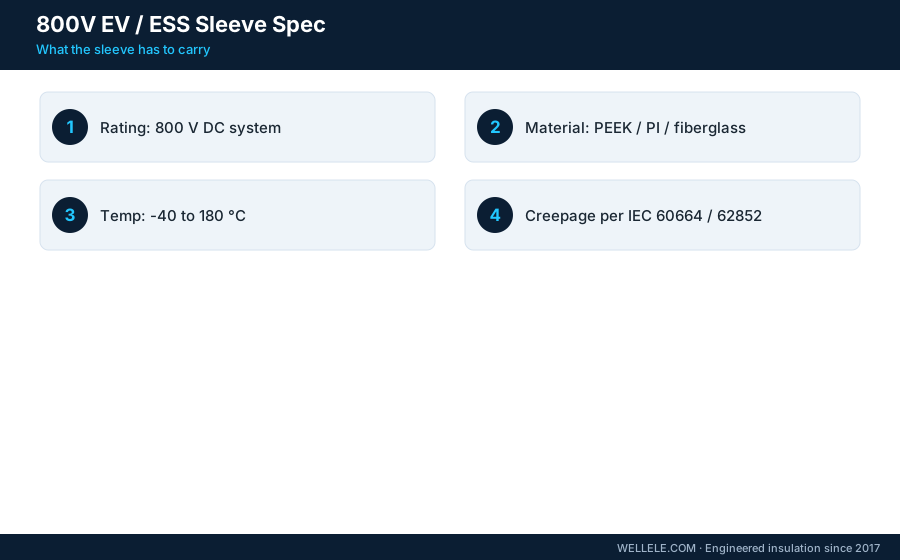
- Pack voltage sets the wall. A 400 V platform and an 800 V platform do not share a sleeve schedule, because recovered wall, creepage and clearance all move together.
- The pack environment sets the material. Flame rating, tracking resistance, coolant exposure and vibration eliminate more candidates than the temperature rating does.
- One drawing set, one supply scope. Tube, sleeve, spacer, box and capillary quoted together, so the interfaces match at first article instead of at pack build.
An EV or ESS pack is a dense assembly of high-current conductors, thin air gaps and a lot of heat. Insulation in that environment is not a single part you can take off a shelf: it is a set of parts whose walls, radii and tolerances have to add up inside the space the pack actually leaves you. That is why we quote this family as a set against the pack drawing.
What the pack asks of each part
| Part | What it does | What sets the size | Where it goes wrong in the field |
|---|---|---|---|
| Busbar heat-shrink sleeve | Dielectric cover over a live conductor and its joint | Bar cross-section, recovered wall, platform voltage | Sleeving the straight run and ignoring the bolted joint |
| Sensor capillary tube | Sheathes thermocouples and sensor leads inside the pack | Bore, wall, sensing response and routing radius | Wall chosen for handling instead of for response time |
| Module and cell spacers | Holds creepage and clearance between modules, cans and terminals | Pitch, tolerance stack and the mounting feature | A nominal thickness quoted with no tolerance window |
| Insulated connection box | Encloses a busbar joint, tap or transition | Bar geometry, phase spacing and cable entry | Clearance checked on the drawing and not on the hardware |
| Thermal barrier and fire sleeve | Slows heat transfer and keeps a flame path off a critical part | Temperature duty and the thickness the space allows | Silicone specified where chemical exposure is the real risk |
| Washers and small parts | Isolates a fastener from the conductor it passes through | Bolt callout, hole tolerance and clamp load | Washer OD too small to hold creepage once it is clamped |
Why 800 V is not a 400 V sleeve
Most of the EV insulation requests we see arrive as a 400 V bill of materials with the voltage on the drawing changed to 800 V. That change moves three things at once, and they do not scale together.
| What changes | 400 V DC platform | 800 V DC platform | Consequence |
|---|---|---|---|
| Recovered wall on a busbar sleeve | Often adequate at a single-wall schedule | Usually needs a heavier or dual-wall schedule | The sleeve you qualified is now the wrong part number |
| Creepage and clearance at the joint | Managed by sleeve alone in many packs | Needs the joint box or a dual-wall treatment | The joint, not the run, becomes the constraint |
| CTI of the material | Standard polyolefin is often accepted | Tracking resistance gets reviewed against the duty | A cheaper compound passes the spec sheet and fails the review |
| Thermal load in the conductor | Lower, with more headroom on the sleeve | Higher continuous conductor temperature | The temperature margin on the sleeve shrinks |

How we size a pack set
- Voltage and system: platform voltage, AC or DC, and the clearance or creepage target your approval file cites.
- Geometry: bar cross-section, bend radii, lug detail, the joint and the phase pitch.
- Thermal duty: continuous conductor temperature, peak events and whether cooling is direct or indirect.
- Environment: coolant or dielectric fluid contact, humidity, salt, vibration and the flame rating the programme requires.
- Volume: prototype quantity and annual volume together, so the ramp cost is visible at quotation.
Components for this solution
Heat-Shrink Busbar Sleeve
Recovers to a tight fit on copper busbars with V-0 flame rating and a rated voltage wall.
800V Busbar Heat-Shrink Tubing
Rated recovered wall and recovery schedule for 800 V EV and energy-storage busbars.
ESS Busbar Insulation Sleeve
Insulation for battery racks, module links and ESS DC busbars.
Busbar Conjunction Box Series
Insulated boxes and covers for busbar joints, taps and transitions.
Polyimide Capillary Tube for Sensors
Thin-wall polyimide capillary for thermocouple and RTD protection inside the pack.
Dual-Wall Adhesive Heat Shrink Tubing
Adhesive-lined sleeve that seals a splice or a sensor joint against moisture.
Shaped High-Voltage Casing Parts (FR-4 / G10)
Machined supports, spacers and barriers for high-voltage assemblies.
G10 / FR-4 Insulating Washers
Epoxy glass washers and spacers for terminal and fastener isolation.
Flange Isolation Kit Sleeves
PET sleeves and washers where a bolted joint also needs a dielectric break.
Silicone-Coated Fire Sleeve
Thermal barrier and flame sleeve for hoses and cables near a heat source.
Related solutions
Busbar Insulation
The full busbar route: sleeve, dual-wall tube, casings and connection boxes, with creepage and clearance worked through.
Mylar (PET) Tubing for Bolts
Where a bolted joint in the pack or the rack needs a dielectric break through the fastener.
Fuse Components
The fuse-side supply scope: bodies, arc-quenching liners, caps and the small parts around them.
Common questions
Do you supply the whole pack insulation set, or only some parts?
We can quote the set or any single part in it. What we prefer is to see the pack drawing or the current bill of materials, even when you only need one item, because the wall on a sleeve and the thickness of a spacer are decided by the same tolerance stack. Quoting one part in isolation is how you end up with an assembly that does not fit.
Can you supply to a 400 V platform and then to 800 V from the same drawing?
No, and we will say so at quotation. The 800 V version needs the recovered wall, the joint treatment and the tracking resistance reviewed again. We will tell you which parts carry over unchanged and which ones move to a heavier schedule, so your qualification plan only re-tests what actually changed.
What flame rating can you hold on pack insulation?
UL 94 V-0 is available across the standard grades in the families we use for packs and racks, with the certificate per batch. If your programme needs a specific declaration format or a substance list, send it at enquiry stage rather than after the sample, because the declaration route sometimes changes the grade we would have chosen.
How do you handle coolant and dielectric fluid exposure?
The material is selected against the fluid, not against the temperature alone. Some grades that hold their dielectric strength in dry air lose it after immersion, and a few swell enough to change the fit. Tell us the fluid by name and whether the part sits in splash or full immersion, and we will choose on that basis.
What tolerance can you hold on a spacer or a capillary?
It depends on the process and the dimension. Wound and moulded parts hold different windows than machined ones, and a bore tolerance is more expensive than an OD tolerance on the same part. We quote the window the drawing asks for, and if something on the print will not hold at the price point you are working to, we raise it at quotation.
Do you provide first-article inspection and batch documentation?
Yes. Material COA traceable to the incoming certificate, first-article inspection per your plan, in-process dimensional records at each station and final inspection reports. On automotive and ESS programmes we work to IATF 16949 style PPAP expectations, and we will tell you early if a feature cannot be gaged the way your plan describes.
Can you work with our drawing or do you need the CAD file?
Either works. A PDF drawing with the critical dimensions marked is enough to quote and to build from. A STEP file helps when the part has a feature the print does not fully define, such as a blend at a mounting boss. If the print and the model disagree, we ask before quoting rather than after.
How long does the sample stage take?
Prototype quantities of a wound or sleeved part are usually days rather than weeks. Parts that need tooling, a composite build or an arc-facing liner take longer, because the drawing goes through engineering review first. Sending the duty along with the drawing is what keeps that review short.
Do you have a minimum order quantity for pack parts?
It depends on whether the size is stock or made to drawing. Standard bores ship in sample quantities. Custom tooling, special laminates and wound parts carry a minimum tied to setup, and we state it at quotation rather than after the sample is approved.
Can you match a part an existing supplier already makes?
Yes, and it is a common request. Send the drawing or a sample plus the duty. One caution: if we only have a sample we can measure what exists, not what the assembly needs, so for anything where a tolerance matters we will ask for the drawing as well.
Do you supply RoHS and REACH declarations?
Yes, across the standard grades in these families, with certificates per batch. If your programme needs a specific declaration format or a named substance list, tell us when you enquire so the correct grade is selected from the start.
What if our duty does not fit anything you make?
Then we tell you, and point at the right family or the right process even when it is not ours. High-voltage duties that genuinely need ceramic, or applications where a standard commercial part is the correct answer, are both cases where saying no costs us one order and saves you a field failure.