Fuse Components
The supply scope for fuse and switchgear builders: LV, MV and HV fuse body tubes, arc-quenching liners, end caps and the small parts around them, produced from one drawing set so the interfaces match.
The 30-second version
- One drawing set, not five suppliers. Tube, liner, washer and cap are held to the same interface dimensions, so the bill of materials closes at assembly.
- Material follows the arc duty. Whether the surface faces the arc decides the family, and it is the single fact that removes most wrong candidates.
- The tolerances that matter are at the ends. Bore, end square and cap interface are what fail at build, not the tube OD in the middle.
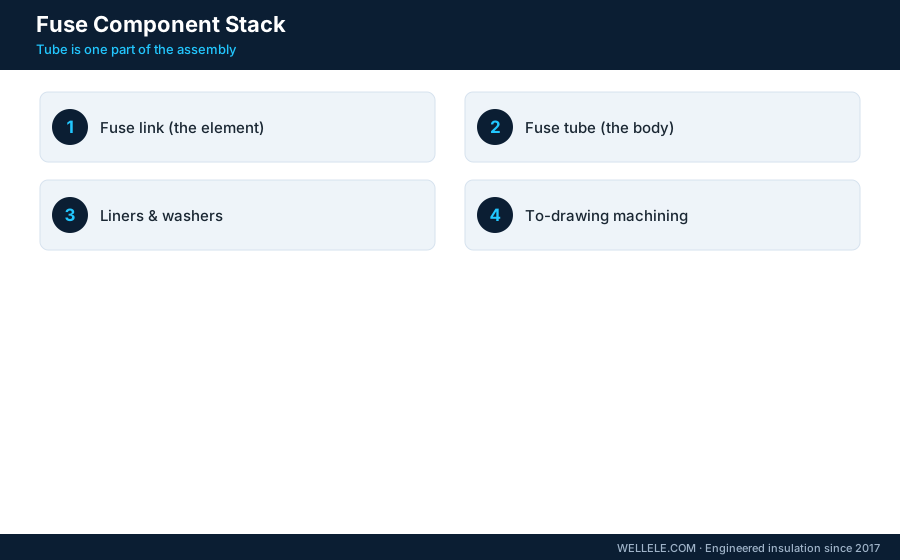
A fuse link is a stack of parts that has to fit and function together: a body tube, an internal liner, an end cap or terminal, and the small insulating parts around them. When those come from separate suppliers, the drawing tolerances add up in the wrong direction and the problem shows up on the assembly line. We supply the set from one drawing review so the interfaces are quoted against each other.
What goes into a fuse link
| Part | Job it does | Material families we use | What decides it |
|---|---|---|---|
| Body tube | Structural shell and dielectric wall of the link | Vulcanized fiber, phenolic kraft, epoxy glass, melamine | Pressure duty, arc exposure and the end-cap interface |
| Arc-quenching liner | Generates gas or ablates to extinguish the arc | Vulcanized fiber, engineered synthetic liners | Breaking capacity and the clearing energy the design absorbs |
| Ceramic-filled epoxy tube | Arc-resistant wall with high tracking resistance | Ceramic-filled epoxy fiberglass | Arc proximity and outdoor tracking duty |
| Melamine tube | Arc-resistant body with high mechanical strength | Glass melamine G5 and G9 | Mechanical strength together with arc resistance |
| Kraft paper tube | Liner, form or low-cost body | Resin-impregnated phenolic kraft | Cost position where arc duty is light |
| Washers and spacers | Isolates a terminal or a fastener | Epoxy glass, vulcanized fiber | Bolt callout, clamp load and creepage after clamping |
| Knurled or screwed tube | End termination without a separate cap | Vulcanized fiber | Feature depth against the remaining wall |
Material by duty, in one view
| If the surface faces the arc | Use | Why |
|---|---|---|
| Yes, and the design relies on gas generation | Vulcanized fiber or a synthetic arc-quenching liner | It ablates and releases quenching gas instead of melting into a conductive path |
| Yes, with high tracking duty outdoors | Ceramic-filled epoxy fiberglass | High tracking resistance and no carbon path forming on the surface |
| Yes, and mechanical strength matters as much | Glass melamine G5 or G9 | Arc resistance carried together with stiffness and impact strength |
| No, it is structure or a liner form | Phenolic kraft or canvas epoxy | Cheaper per part where the surface is not asked to quench |
| No, it is the outer structural shell | Filament wound fiberglass or fiber and epoxy combination | Hoop strength and burst performance with a controlled wall |

Information we need to quote a fuse component
- The governing standard your link is designed to, and the dimensions it fixes.
- Voltage class and breaking capacity the body and liner have to survive.
- ID, OD, wall and length with the tolerances that matter marked, especially at the ends.
- The end-cap or terminal interface: fit, engagement length, datum scheme and any thread or knurl.
- Bore and venting arrangement where the design relies on gas generation.
- Finish, marking, and acceptance criteria, plus prototype and annual volume together.
Components for this solution
Custom Vulcanized Fiber Tubes
Rolled and machined vulcanized fiber (fish paper) fuse bodies, thin-wall and small-diameter, to your drawing.
Ceramic-Filled Epoxy Fiberglass Tubes
Arc-resistant, high tracking resistance tubes for current-limiting and HV fuse links.
Medium and High Voltage Fuse Link Bodies
Cylindrical fuse bodies for MV and HV links, with end-cap interfaces machined to spec.
Small-Diameter Thin-Wall Fuse Tubes
Thin-wall vulcanized fiber and epoxy tubes for compact cylindrical links.
Phenolic Kraft Paper Tubes
Resin-impregnated kraft paper tubes for liners, forms and low-cost fuse bodies.
G5 / G9 Melamine Tubes
Glass melamine tubes with high mechanical strength and arc resistance.
Fiber-Epoxy Combination Tubes
Layered vulcanized fiber and epoxy glass for combined arc performance and strength.
Vulcanized Fiber and Fiberglass Tubes
Fiber inner with fiberglass reinforcement for stronger thin-wall bodies.
Canvas Epoxy Fuse Tubes
Phenolic cotton canvas tubes for cost-effective mechanical fuse bodies.
Knurled and Screwed Fiber Tubes
Vulcanized fiber tubes with knurl, thread or shoulder for end termination.
Synthetic Arc-Quenching Fuse Tubes
Engineered arc-quenching liner materials for high clearing energy duty.
G10 / FR-4 Epoxy Glass Washers
Precision epoxy glass washers for terminal and busbar insulation.
Fuse Body Tube for Power Protection
Bodies for power protection links, with the material matched to the duty.
Current-Limiting Fuse Tubes
Epoxy glass tubes for current-limiting links, where the wall absorbs the let-through energy.
Vulcanized Fiber Washers
Fish paper washers and spacers for terminal isolation inside the link.
Related solutions
MV/HV Fuse Body Tubes
The selection route from 1 kV to 36 kV: which material faces the arc and which one only carries the structure.
Busbar Insulation
Sleeve, dual-wall tube and connection boxes for the conductor side of the same switchgear.
EV & ESS Insulation Components
Pack and rack insulation where the same fuse is mounted on a battery platform.
Common questions
Can you supply the complete fuse link bill of materials?
Yes. Body tube, internal liner, insulating washers and the small parts around them can all come from one drawing set, which is usually the point of the enquiry. Parts that are metal, or that need plating or a spring property, we will tell you plainly are outside our scope rather than quote them through a third party.
Which material should face the arc?
Vulcanized fiber or an engineered synthetic arc-quenching liner when the design relies on gas generation, ceramic-filled epoxy or glass melamine when the duty is arc proximity with tracking. Everything else in the link is structure or a form, and those can be cheaper. If you are not certain which surface is arc-facing in your design, send the link drawing and we will mark it up.
How do you hold the end-cap interface tolerance?
The interface is inspected as a feature in its own right, not inferred from the tube OD. Bore, end squareness and engagement length are gaged against the datum scheme on your print, and where the print does not define a datum we ask before quoting, because guessing there is how a batch scatters at assembly.
What thickness of wall do you recommend for a given voltage class?
Wall is set by the clearing duty and the mechanical load, not by the voltage class alone, so there is no honest single number to quote. What we do is take your breaking capacity and the material you have chosen, then check the wall against both the dielectric duty and the burst or crush load before the price goes out.
Do you make thin-wall and small-diameter bodies?
Yes, including thin-wall and small-diameter parts with tight tolerances for compact cylindrical links. That work is where the tube process matters most, because a small bore with a thin wall leaves very little room for run-out, so we discuss the machining and the gaging method before the sample.
Can you work from a sample of a part we already buy?
We can, and it is a common route for a second source. Be aware that from a sample alone we measure what exists rather than what the assembly needs. If the only reason you are re-sourcing is that the current part is marginal, send the drawing as well so we can fix the marginal dimension instead of copying it.
How do you handle certification for a new link?
We supply the material COA traceable to the incoming certificate, first-article inspection per your plan, in-process dimensional records and final inspection reports. Dielectric, immersion and burst testing are available on request where the duty calls for them. The certification of the finished link stays with you as the link maker; we provide the evidence the tube and liner contribute.
What documentation comes with a batch?
Material certificate traceable to the incoming lots, dimensional records at each station, final inspection report, and RoHS and REACH declarations for the standard grades. If your customer requires a specific format or a certificate of compliance per shipment, tell us at enquiry stage so it is built into the process rather than added afterwards.
How long is lead time for a custom fuse body?
It depends on whether the part needs tooling and on the process. A rolled fiber tube to a known drawing is faster than a wound or moulded body, and a first article adds time on any new part. We quote lead time per part and per finish rather than giving one number for the family.
Do you have a minimum order quantity?
It depends on whether the size is stock or made to drawing. Standard bores ship in sample quantities. Custom tooling, special laminates and wound parts carry a minimum tied to setup, and we state it at quotation rather than after the sample is approved.
Can you supply the liner as a separate item?
Yes, and sometimes that is the right answer when your tube supply is already settled and only the arc-quenching liner is under review. Send the bore it has to fit and the clearing duty, and we will quote the liner against the interface rather than against a nominal wall.
What if our duty does not fit any material you make?
Then we say so and point at the right family. High-voltage duties that genuinely need a ceramic body, or designs where a standard commercial part is the correct answer, are both cases where telling you no costs us one order and saves you a field failure.